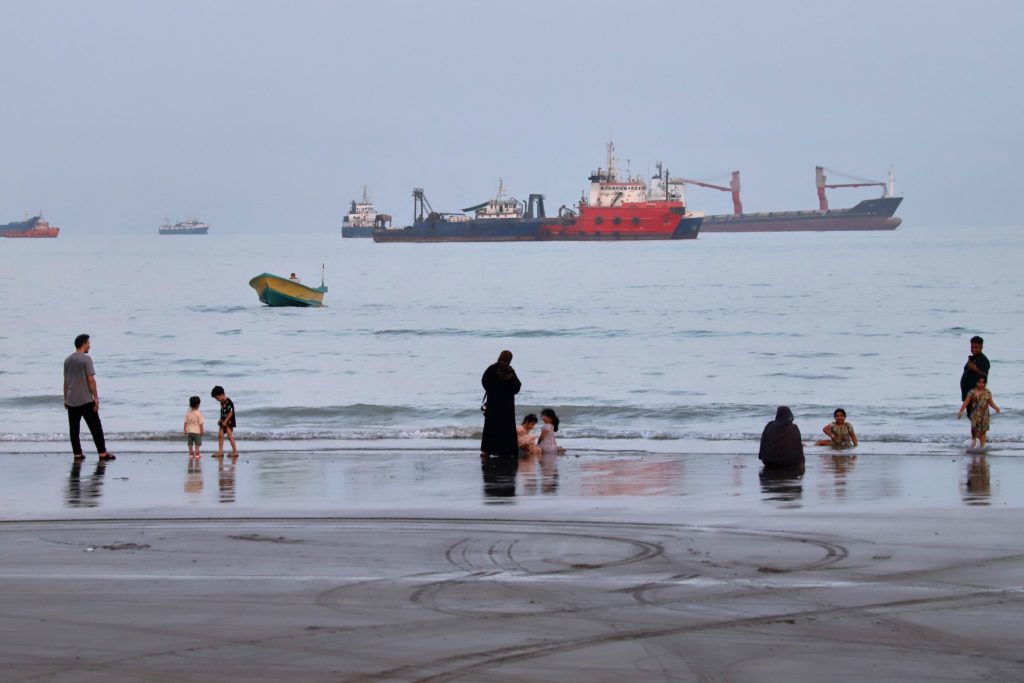
President Trump lashed out at U.S. allies on Monday as the deadline to reach a deal to end the war with Iran expires. Trump threatened to bomb Oman, which has been mediating negotiations, and called for military exercises with South Korea to be scaled back, in part for refusing to join the war. Amna Nawaz discussed where the war stands and what happens next with Alan Eyre and Reuel Marc Gerecht.
Notice: Transcripts are machine and human generated and lightly edited for accuracy. They may contain errors.
I like the idea of declaring it a territory.
We have total control over the strait. We're taking out millions of barrels of oil a week. If you look at the kind of numbers that we're doing, we're doing -- the strait is open.
For an assessment of where the war stands and what happens next, we get two views.
Alan Eyre was a State Department subject matter expert focusing on Iran and a senior member of the Obama administration's negotiating team for the Joint Comprehensive Plan of Action, or JCPOA, deal with Iran. He's now at the Middle East Institute. And Reuel Marc Gerecht was a CIA operations officer in the Middle East in the 1980s and '90s. He's now a senior fellow at the Foundation for the Defense of Democracies.
Reuel Marc Gerecht, Senior Fellow, Foundation for the Defense of Democracies: My pleasure.
Alan, I will start with you because you have made clear you opposed this war with Iran from the beginning. This memorandum of understanding the U.S. and Iran signed back in June was supposed to do a few things, calling for an end to military operations, for the U.S. to end its naval blockade, for Iran and Oman to define the future administration of the strait.
The 60 days are up. Why didn't this work?
It didn't work because there was a total absence of any type of mutual goodwill. And so, when you reach the ambiguity that's in even the best of MOUs -- and, in this case it was about Article 5 of the MOU about how to administer the Strait of Hormuz in the temporary period -- the ambiguity killed it, because it said Iran will administer, in essence, traffic through the strait.
But the U.S. also was trying to get ships through the southern coast along the Omani border. That is what -- that was the fatal flaw that blew up the MOU. So it's like a -- it's like a sprinter tripping out of the starting gate. It never really got a chance.
Reuel, we should point out you supported the war. I don't know if you do still, but you have. Why do you think the 60-day deal collapsed?
Reuel Marc Gerecht, Senior Fellow, Foundation for the Defense of Democracies: Well, I'd have to back it up a little bit. I would put the onus here on the United States, in that I think it was crystal clear that the Iranians had no intention whatsoever of giving up their claim to control the straits and to put levies on ships.
At the time they were negotiating this, if you were to read Revolutionary Guard Corps publications, this -- it was clear. I mean, there was no ambiguity there. So I don't know what Vice President Vance and others were doing in those negotiations, and I think they should have known that the Persian version of this was not the version that the Americans believed perhaps was going to come into play.
I think they were just being hopeful. I think the United States wanted to get out of this war, and so was accepting a memorandum of understanding that really had no grounding in reality.
So the U.S. is -- President Trump, we should say, is claiming that the U.S. does control the strait, that the U.S. could control it and claim it as a territory. Is any of that true?
I think President Trump often says stuff for different reasons. I don't think there's a necessary correlation between what he says at any given time about the situation and any underlying reality.
So, no, we don't control the strait. The crucial factor here is Iran possesses the de minimis military ability to threaten traffic so that traffic will not go through the strait. That's not going to change. Unfortunately, despite the fact that our military is so much stronger, we cannot open and keep open the strait militarily.
Also, it is true that Iran has decided it wants to keep control of the strait as a form of strategic deterrence, and that's the hill that literally it's going to die on.
I don't think there's any chance the Iranian leadership is going to relent. I actually think they want to intensify the war. That's why the president, I think, has now decided to put all his chips onto the blockade and sanctions, economic warfare, to try to either bring the regime to the table or to collapse it.
However, I don't think that option, it can be accomplished quickly, if it can be accomplished. And the clock could be very long on that.
Well, the president continues to say that Iran does want to make a deal, but, as you point out, there's been economic sanctions, economic squeezing, a bombing campaign, a naval blockade. None of that has worked.
What would bring the Iranians to the table?
Oh, I don't think anything will bring the Iranians to the table. I don't think they have any intention.
I think, right now, they believe in pushing this conflict actually gives them the best chance of seeing the United States fail, to actually have to admit defeat and withdrawal. So I think that's what they're after. They want the United States to effectively withdraw from the Persian Gulf. They intend to dominate the Arab Gulf countries, to make them tributaries.
I don't see them relenting. And the president of the United States, I think, has made it crystal clear that he doesn't want to fight the battle of Hormuz, and that he wants to go and try this economic approach. And one can understand. There's some foundation there.
I mean, the Islamic Republic is an economic basket case. But these individuals who rule the country are extremely hard. They have killed thousands of their own people to stay in power, and I just don't see them relenting.
I agree with much of it, but I do think that Iran is open to negotiation. They have it -- but they're going to negotiate while fighting. The decision Iran has made collectively in the last week or so is that they're not going to decrease economic pressure on the West of the United States by reopening even partially the strait because they don't want to lose the initiative they feel they have.
The Iranian leadership now, more hard-lined, more militarized, thinks they're at a wartime footing. You know, they have gone to the mattresses. They don't expect hostility from the U.S. or Israel to stop. So what they need to do in their minds is prepare for ongoing war. And the control of the strait is an essential component of that.
Now, if the U.S. decides to lift sanctions, unlikely, $300 billion dollar reconstruction development, unlikely, unblock assets, less unlikely, then they might take it seriously, because they do need money, right? But they could just as well try to cut separate deals with the six Gulf countries for revenue streams.
Because the two things they want, control of the strait for security, some form of income, because, as you point out, they are hurting economically.
President Trump also continues to restart the bombing campaign. Would additional military pressure change the landscape?
No, but that's the whole point. The theory of the case that, if we just keep escalating until Iran either capitulates or collapses, isn't going to work, because the people have been charge of Iran right now, if the pain gets to a certain point -- and don't forget, they're not feeling pain. They make money off sanctions.
The Iranian people are getting the preponderance of this pain. But at a certain point, if they're starting to feel pain themselves, they escalate against GCC energy and economic infrastructure to get the U.S. to stop. So I don't see the theory the U.S. is pursuing in this war.
Well, given where this is now, six months into the hostilities, do you look back on the decision for the U.S. and Israel to launch the war in the first place as a mistake?
Yes, I mean, given our reluctance to actually do what is necessary, which at a minimum means we're willing to fight the battle of Hormuz.
Well, it may require that, yes. You may have to have troops on the islands and on the mainland littoral.
I would be very curious to know what the U.S. Navy, when it was doing the briefings before this war happened, what they told the president. Did they tell the president that you could fight the battle of Hormuz? Did they mention the battle of Hormuz? Did they say you could do it without ground troops? I mean, I -- or did the president discard that information?
But it's quite clear now that we're not willing to fight that battle. And if we're not willing to fight that battle, I don't think we could win. So -- and I'm -- yes, economic coercion has its place, but I don't think it can replace real warfare, kinetic warfare.
So I think they can probably outlast us. I mean, that's a question that should go to Secretaries Bessent, Treasury, and the naval secretary of how long we can go on and endure, particularly if they start firing again at the Gulf Arab energy infrastructure, and they're able through their Houthi allies to shut down Red Sea traffic.
Then I think, economically, we're in a very bad situation.
Reuel Marc Gerecht, Alan Eyre, thank you so much for being with us.
Amna Nawaz serves as co-anchor and co-managing editor of PBS News Hour.
As the deputy senior producer for foreign affairs and defense at the PBS NewsHour, Dan plays a key role in helping oversee and produce the program’s foreign affairs and defense stories. His pieces have broken new ground on an array of military issues, exposing debates simmering outside the public eye.