At a time when the impact of climate change is undeniable, some researchers suggest we need to start work on far more ambitious approaches for tackling these problems. These proposals are often referred to as geoengineering. Science correspondent Miles O’Brien looks at one such concept to deal with the melting of glaciers and sea ice. It's for our series, Tipping Point.
Notice: Transcripts are machine and human generated and lightly edited for accuracy. They may contain errors.
At a time when the impact of climate change is undeniable, some researchers suggest we need to start work on far more ambitious approaches for tackling these problems. These proposals are often referred to as geoengineering .
Science correspondent Miles O'Brien looks at one such concept to deal with the melting of glaciers and sea ice. It's for our series Tipping Point.
It's time for some scientific fieldwork. Fortunately, mathematician and climate researcher David Holland of New York University has a short commute. The glacier he is studying is right on his doorstep.
It's life-changing when you actually experience it and see it. It transforms it to something very real.
This is Greenland's Jakobshavn Glacier, which has a peak flow rate of about 150 feet a day, one of the fastest moving glaciers on Earth.
You're losing more than you're gaining. So it's like a bank account that's being dwindled down.
He is joined by his partner in every respect, wife Denise Holland, the logistical genius that makes it all happen in this tricked-out scientific encampment.
We have been doing this for 20 years, and for 20 years I have been sleeping on the ground on a tent. So when the opportunity came along, I said, OK, let's do this right.
Just before they left for Greenland, we caught up with them as they were tallying and testing gear at their home base in the East Village of New York City.
This is the packing stage for the luggage, and it's controlled chaos,yes. So that's what I do. I use the skills that I have to kind of make sure everything goes where it's supposed to go.
They're hoping to better understand the glacier's rapid retreat by gathering synchronous data from radar, seismic sensors, drones, weather stations, and satellites.
There's no A.I. way out of this. This is just go get data, and that's why we want synchronous data, so something will pop out, and we will say, uh-huh.
Ultimately, they want to improve predictions on how much and how soon this and other glaciers will add to sea level rise. And that's what propels them on a bipolar scientific odyssey.
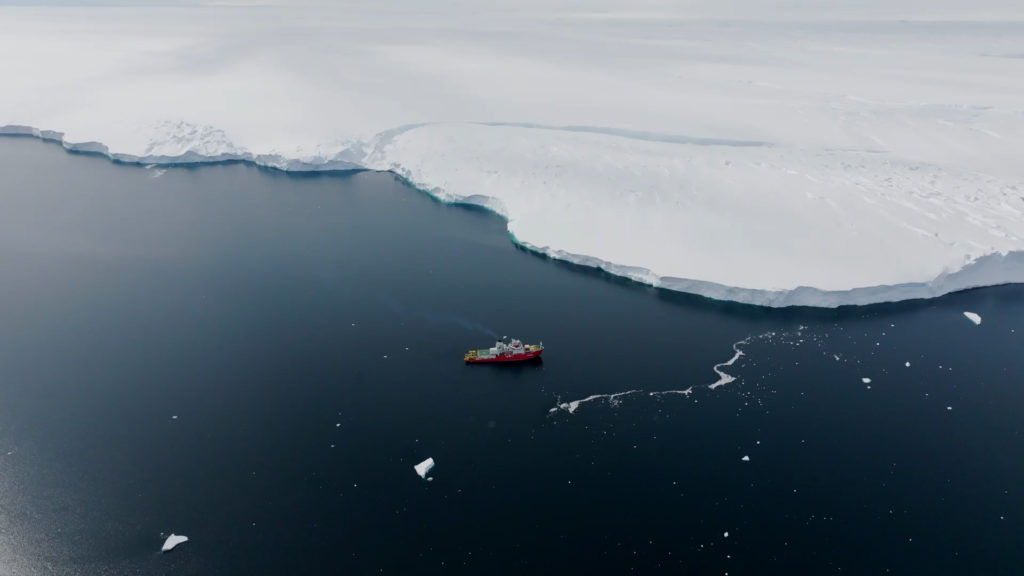
Four months before he set up camp in Greenland, I joined David on a voyage to Antarctica to the Thwaites Glacier. The size of Florida, it and the ice it holds back store enough water to raise global sea levels by as much as 10 feet, and it is melting at an astonishing rate, losing about 300 feet of thickness every year.
Undeniably, it's melting. Then the question is, why?
Warm, salty, dense seawater flows beneath a layer of cold, fresh meltwater, where it attacks the glacier from below, accelerating its melt. But researchers need more data to say much beyond that.
We have a few measurements, a few snapshots, but we have never gotten the sustained measurement at Western Thwaites.
Holland had hoped to deploy a sophisticated temperature sensor into the sea beneath the glacier. Unfortunately, the effort came up short. As the sensors descended, the super cold glacier ice grabbed them and wouldn't let go. It was a crushing blow.
But David Holland had another mission on his manifest for this cruise. Five days after the sensor deployment went awry on the glacier, we were 80 miles away, and he was on the poop deck orchestrating the deployment of a pair of robotic moorings.
Yes, this goes first, and the line will go out.
They are designed to continuously climb and descend on the rims of an underwater canyon that funnels warm water toward Thwaites. Holland hopes the buoys will provide some initial data on the feasibility of a crazy-sounding idea. Could an underwater barrier, a so-called sea curtain, slow down the melting?
He showed me a 3-D scale model of the undersea terrain near the glacier.
It's quite a coincidence that this particular slice of Antarctica is the place where the warm water is butting up against the continental shelf break.
For thousands of years, the continental shelf protected Thwaites from exposure to a strong deep current of dense warm water that circulates around Antarctica.
But researchers believe climate change has altered wind patterns here, creating a pathway for deep warm water to spill over the continental shelf and flow to the Thwaites grounding line.
This is such a small region of the Earth that it just might be possible to block it and pinch it.
The undersea canyon is nearly 60 miles wide. The twin robots will measure the depth of the warm water and the strength of the ocean currents, critical data for determining whether an underwater barrier is even feasible.
This modification could potentially stop that warm water and block it up. And if this height is adequate, the water will be at bay.
But none of this is keeping critics of the idea at bay.
Rob Larter is a Marine scientist with the British Antarctic Survey.
It really seems like something that's very impractical to me.
The underwater barrier is just one of a handful of geoengineering ideas aimed at slowing the loss of glacier ice that Larter finds fault with.
Some of the other ideas include draining the meltwater from beneath glaciers to reduce their slide toward the sea, artificially thickening sea ice to support glacier fronts, injecting aerosols into the air to reduce the amount of sunlight that gets through, or spreading reflective material over the snow and ice to reduce the melting.
After looking at them from various different aspects, from the feasibility, from how quickly they could be developed to a stage where they might be deployed, from the potential adverse consequences, ecological effects from the difficulty of governing them in a very geopolitically complex world, none of them, none of them pass these tests.
David Holland takes great pains to remind us he's not building a sea curtain, but, rather, a trove of data that can inform a decision on whether a barrier makes sense someday in the future.
Now, in Greenland, the people of Greenland will decide, in Antarctica, less clear. But without this data we're collecting for Greenland and Antarctica, humanity will be left without an engineering solution to stabilize these glaciers.
Between Thwaites and Jakobshavn, David and Denise Holland are moving from the frying pan to the fire at two of the most consequential glaciers on the planet. They are scrambling to create a forecast of how long the world's glaciers might last and pondering the audacious notion that humans could do something about it besides reducing our appetite for fossil fuels.
Can it solve it completely forever? No, because if you keep warming the atmosphere, this is going to retreat faster.
The Hollands have a front-row seat to a global problem that is moving at glacial pace. But that may not be as slow as we imagine.
For the "PBS News Hour," I'm Miles O'Brien.
Miles O'Brien is an Emmy, Peabody, and duPont Award-winning broadcast journalist, documentary filmmaker, and one of America's leading science correspondents. For more than four decades, he has reported from every corner of the globe covering science, technology, aerospace, climate, medicine, and the environment.