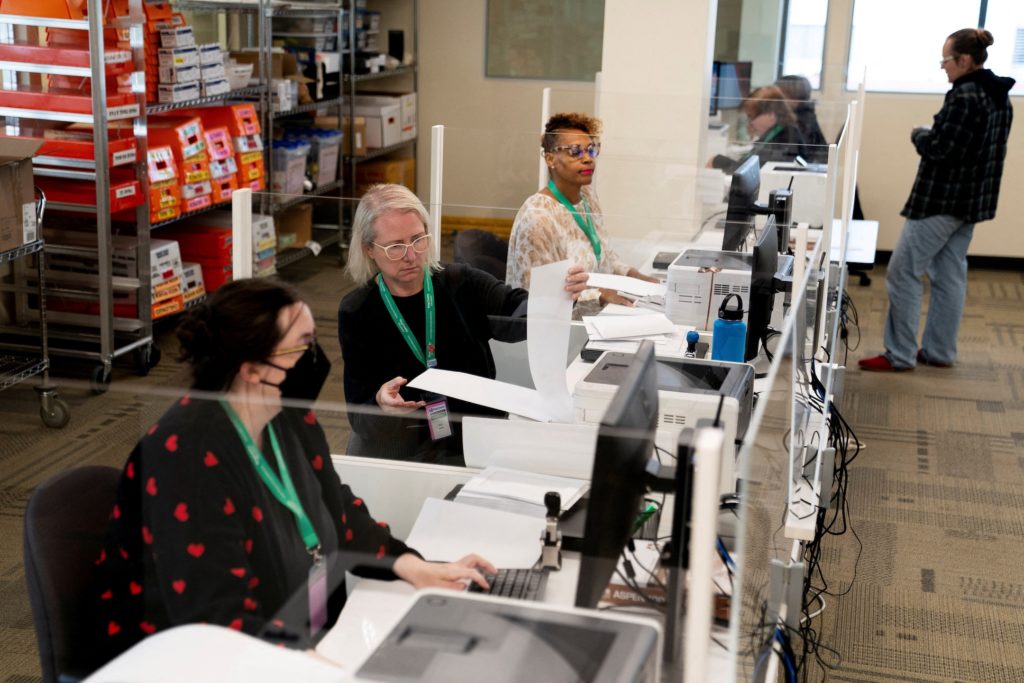
Defense Secretary Hegseth directed military commanders to have a one-day “stand down” this month so service members have time to vote in the midterms. In King County, Washington, ballots are already being processed from service members and Americans living abroad. Some arrive by mail. Some by email. Liz Landers takes a look at how those ballots are verified and counted and how secure they are.
Notice: Transcripts are machine and human generated and lightly edited for accuracy. They may contain errors.
And even as campaign spending is ramping up, voting in the 2026 midterm elections is well under way. And, today, Defense Secretary Pete Hegseth directed military commanders to have a one-day stand-down this month, so service members have time to vote.
We're going to take the time to ensure that you can vote and that your voice is heard. You are the best citizens of our country, and therefore you should have every opportunity to exercise your right to vote.
In King County, Washington, which is home to Seattle, ballots are already being processed from service members and Americans living abroad. Some arrive by mail. Others arrive by e-mail.
Our Liz Landers takes a closer look now at how those ballots are verified and counted and how secure they are.
Envelopes like this one took the long way here sent from voters thousands of miles away as far as Antarctica. They're some of the first ballots of the midterm elections, part of a batch sent out in mid-September to service members and Americans abroad.
Julie Wise, Director of Elections, King County, Washington: Our democracy is at its finest when all voices are heard.
Julie Wise Is the elections director in King County, Washington, home to 1.4 million registered voters, including 32,000 living overseas.
These are voters going to be all over the country or all over the world in some of the most remote parts of the world, right? And so law says we need to get those ballots out early to those voters.
Voters overseas can get their ballot in the mail or mark it online, print it, and send it back. In Washington state, they can also just e-mail it. That presents unique challenges for election workers. Like all mail ballots, they require a voter declaration and signature match.
This is relatively small amount of voters that use electronic ballot return. It's an attached PDF. It's not online or Internet voting here in Washington state at least.
And so we're still doing the checks and balances to make sure that, not only through the cybersecurity aspect, but that the ballots when they're physically backed in our facility are still going through all of those checks and balances.
The cheating on mail-in voting is legendary. It's horrible, what's gone on.
For years, President Trump has portrayed mail ballots as an open door to fraud, a claim the evidence does not support.
In fact, a Brookings Institution analysis of the 2016, 2018, 2020, and 2022 general elections found about four cases of mail voting fraud per 10 million votes cast. He's also said, without backing it up, that election machines are prone to hacking.
I think we really got to stop the narrative that our elections here in America are not accurate and secure. They are, and they have been for a long time.
The vote tabulation machines never go online, but ballots like these do.
Despite that, Trump says members of the military should still be able to vote by mail.
There's no mail-in ballots, with the exception of disability, illness, military.
Federal agencies have warned that e-mail is the riskiest way to send a ballot back. About 30 states allow it anyway. It's a trade-off, a little less security so service members overseas still get their ballots home in time.
We do have to balance that risk over access. They still have the right to be able to have their voices heard and to vote in each election.
David Becker, Executive Director, Center for Election Innovation and Research: The choice is, do we let them return it electronically in some way, often with a paper backup as well, or do we disenfranchise them?
David Becker leads the center for Election Innovation and Research and previously worked in the voting section of the Justice Department. He also sees a balancing act for election officials.
We could have a very, very secure voting system that involves every single person voting at one location during a five-minute window and having to give a blood test and a DNA sample. That would not enfranchise people.
We could also have a really accessible system where everyone just put their ballot on a Google sheet and we counted it that way. But that would not be secure. So election officials are trying to balance those things out all the time.
To ensure ballot accuracy, election officials print out the e-mailed ballot, creating a physical paper trail when it comes time to tabulate votes.
It's secure enough, particularly when secrecy is waived, because you can go back to the voter and say, hey, we want to confirm you voted this way. That's not the way it is for most ballots.
Nationally, more than one million of these ballots went out in the last presidential election. Most went not to troops, but to civilians living abroad.
For voters whose mail is slow, the Supreme Court this summer decided states can keep counting ballots cast on or before Election Day, even if they arrive later.
Every single ballot in the United States has to be voted and relinquished by the voter by Election Day. There's no one who's allowed to vote after Election Day.
In King County, envelopes like these will keep trickling in for three weeks after the polls close. Some are returned with a little something extra.
Who doesn't like a voting selfie? We encourage voting selfies. Voting selfies are legal in Washington state.
And every one has to be checked before it counts.
For the "PBS News Hour," I'm Liz Landers.
Liz Landers is a correspondent for PBS News Hour, where she covers the White House and the Trump administration. Prior to joining the News Hour, she served as the national security correspondent for Scripps News, and also reported on disinformation for the network.
Matt Loffman is the PBS NewsHour's Deputy Senior Politics Producer