Mandatory cuts from the federal government on water from the Colorado River will soon take effect in Arizona, Nevada, and California. Now, some water managers in the region are spending billions to prepare for a drier future. Special correspondent Ben Tracy with Climate Central reports for our series, Tipping Point.
Notice: Transcripts are machine and human generated and lightly edited for accuracy. They may contain errors.
The two largest reservoirs in the country, Lake Mead and Lake Powell, created by dams along the Colorado River, are at historic lows, threatening a critical water supply for more than 40 million Americans.
Now new mandatory cuts from the federal government on water from the Colorado River will soon take effect in Arizona, Nevada, and California. It's a fight that could end up at the Supreme Court.
But, for now, special correspondent Ben Tracy with Climate Central shows us how some water managers in the region are spending billions to prepare for a drier future. It's part of our series Tipping Point.
Colby Pellegrino, Deputy General Manager of Resources, Southern Nevada Water Authority: This is Lake Mead. Lake Mead is the largest manmade reservoir in the United States.
Out on the waters of Nevada's Lake Mead...
Colby Pellegrino with the Southern Nevada Water Authority...
What is that there sticking out of the water?
... showed us something we shouldn't be seeing.
That is the first intake that was built to bring municipal water into the valley in 1970.
And that's part of how you get water out of Lake Mead to Las Vegas?
It is no longer part of how we get water to Las Vegas because the lake has dropped too much for this piece of infrastructure to be operable.
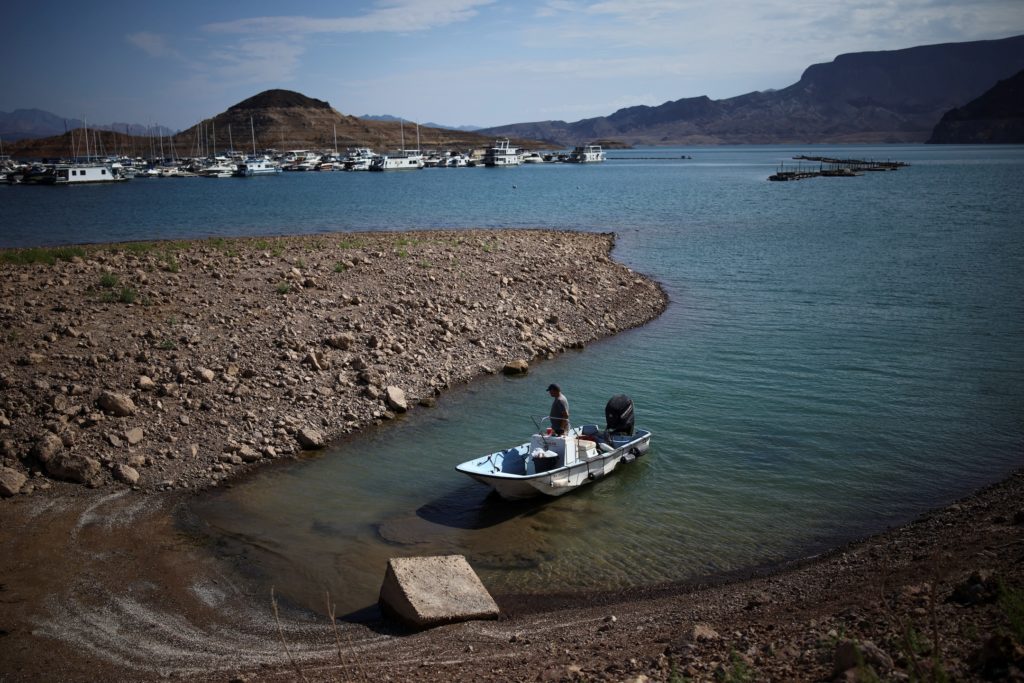
It should be underwater, but Lake Mead is at its lowest level ever. That white line shows where the water was back in 2000, 175 feet higher. This reservoir on the Colorado River provides Las Vegas with more than 90 percent of its water supply.
Some people are calling this a crisis on the river. How do you view it?
If it's not a crisis, it's crisis-adjacent.
In the early 2000s, the Water Authority here spent more than a billion dollars on a new intake, nearly 200 feet lower in the lake, along with this massive pumping station, expensive insurance against a day they hoped would never come.
What does it say that you're now using it?
I think it says that somebody had the climate projections right.
The Colorado River begins in the Rocky Mountains and supplies water to more than 40 million people across seven states, including major cities such as Phoenix, San Diego, and Los Angeles, as well as five million acres of farmland.
Kyle Roerink, Senior Adviser, Great Basin Water Network:
Kyle Roerink is a senior adviser with Great Basin Water Network, a nonprofit focused on water conservation in the West. He says decades of overuse combined with a 26-year-long megadrought have left the river's two largest reservoirs, Lake Mead and Lake Powell, at just 25 percent of their combined capacity.
Think of them as a bank account. And when you see the bathtub ring and exposed shoreline, you need to think, are we going bankrupt?
The megadrought in the Southwest is now the worst in more than 12 hundred years. Record low snowpack in the Rockies last winter sent reservoirs plummeting. And Climate Central reports that, since 2000, the drought is driven not only by a lack of snow and rain, but also by extreme heat that pulls moisture from the soils and streams.
The Colorado River has lost 20 percent of its flows since the turn of the 21st century. It's a basic problem of just, like, supply and demand.
Just a few more feet of decline at Lake Mead could reduce hydropower generation at Hoover Dam by 70 percent. And now the federal government is cutting the supply of Colorado River water to Nevada, California, and Arizona.
Max Wilson, Water Resources Management Adviser, Phoenix, Arizona:
What these cuts mean for Arizona is approximately a 50 percent cut to the Central Arizona Project.
Max Wilson is the water resources management adviser for the city of Phoenix.
So this water starts all the way in the Colorado Rockies in tiny mountain streams.
It travels through the 330-mile-long Central Arizona Project Canal to Phoenix.
Colorado River water is about 40 percent of the water that the city of Phoenix provides to customers. In some parts of the city, it's almost 100 percent.
Arizona could eventually lose all of its Colorado River water, so Phoenix is investing billions of dollars in three new water recycling plants.
This is Phoenix's first advanced water purification facility.
It will take water that's already been used in homes and purify it with reverse osmosis and ultraviolet light, giving it a second life.
When the plant opens next year, it's expected to produce nearly seven million gallons of recycled water every day.
It's one piece of the pie as we're trying to figure out how to live with less Colorado River water, but it's an important piece of the pie because it is so reliable.
Kyle Roerink says the price of water in the West will keep rising as these reservoirs fall.
Is the era of cheap unlimited water over?
That's over. Those days are gone. We are going to be able to weather the storm, but it's going to be very expensive.
For the "PBS News Hour," I'm Ben Tracy with Climate Central.