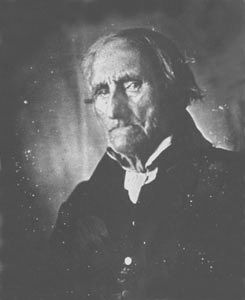
Helmuth von Moltke, born in 1800, is the oldest known person to have their voice preserved. The post Introvert irony: The earliest-born human to have his voice recorded was famous for not talking appeared first on Upworthy.
Thomas Edison invented the original phonograph in 1877, the first device in history to capture sound in a way that allowed it to be played back later. The very first recording on the device was Edison himself reciting a few lines from the nursery rhyme, “Mary Had a Little Lamb.”
The original phonograph was cheap and disposable, using tinfoil wrapped around a metal cylinder. Within 10 years, Edison perfected his design into the solid wax cylinder, which was more durable and of higher quality.
One of his first orders of business was to send an employee across Europe, armed with several of these phonographs, to capture the voices of some of the most powerful and influential figures. For the very first time.
Edison chose his laboratory assistant, Theo Wangemann, for the task.
In 1889, Wangemann visited Germany and sat with Chancellor Otto von Bismarck and even recorded Johannes Brahms playing his own music; the first time it had ever been recorded.
But perhaps the most unusual and interesting person he recorded on his trip was Helmuth Von Moltke the Elder, the longtime chief of staff of the Prussian Army. This visit ultimately produced the recording of the oldest human voice on record. Von Moltke was born in the year 1800, making him about 88 years old at the time of the recording.
Fascinatingly, being the oldest living voice ever recorded might have sat strangely with Von Moltke: he was famously known for being a man of few words and was even nicknamed “The Great Silent One.”
In his recording on Edison’s phonograph, Von Moltke introduced himself and read lines from Shakespeare’s Hamlet and Goethe’s Faust.
It’s incredible to think that only one voice from a person born in the 18th century has ever been recorded and preserved. Even more incredible is that it was a man legendary for hardly speaking a word, described as being “silent in seven languages.” To add to the irony, he was also a prolific and talented writer.
Von Moltke was born in the year 1800. For context, the photograph, the railroad, and the light bulb had not yet been invented. People still traveled primarily by horseback. The man was a young adult when Beethoven began composing his famous 9th Symphony. Von Moltke was a teenager when Napoleon was defeated at the Battle of Waterloo.
Before he died in 1891, the world had changed drastically. He’d been photographed and had his voice recorded on a phonograph; it must have absolutely astounded him.
(Although Von Moltke is regarded as the earliest-born person to have their speaking voice recorded, he is not the earliest-born person ever photographed. That honor belongs to Conrad Heyer, a veteran of the American Revolutionary War, born in the mid-1700s and photographed in 1852.)
Edison’s phonograph took the world by storm. His associates traveled the world, capturing everything from epic Victorian parties to crowds at the World’s Fair to world-famous composers.
Many of these records, including Von Moltke’s, were lost until after Thomas Edison died in 1931. They’d sat in storage for decades in a wooden box. Even then, it took nearly a century for historians to restore and identify many of the voices. It wasn’t until 2012 that researchers matched Von Moltke’s cylinder phonograph recording to his identity.
Of all the icons recorded, only Von Moltke wears the honor of being the oldest and earliest-born person to have his voice immortalized. It’s an honor at odds with his reputation and personality, yes, but an amazing privilege for the rest of us who get to listen and hear history come alive like never before.